

“Companies now expect their travel partners to understand more about their business, and they want programs that reflect how they actually operate rather than something generic,” said Jo Lloyd, FCM Global Head of Customer Management and Consulting.
That expectation is spreading across the travel ecosystem, she added, as airlines, hotels and ground transport providers are being asked to better recognize the needs of different traveler types and industries.
Key takeaways
- Tailoring is increasingly about how programs are delivered and governed—not just adding new tech.
- Well-fit policies, servicing and communications improve compliance and visibility by matching how people actually travel.
- Tailored approaches are spreading beyond highly regulated or mission-critical travel segments as risk, privacy and sustainability needs rise.
Travel Tech Leads the Way
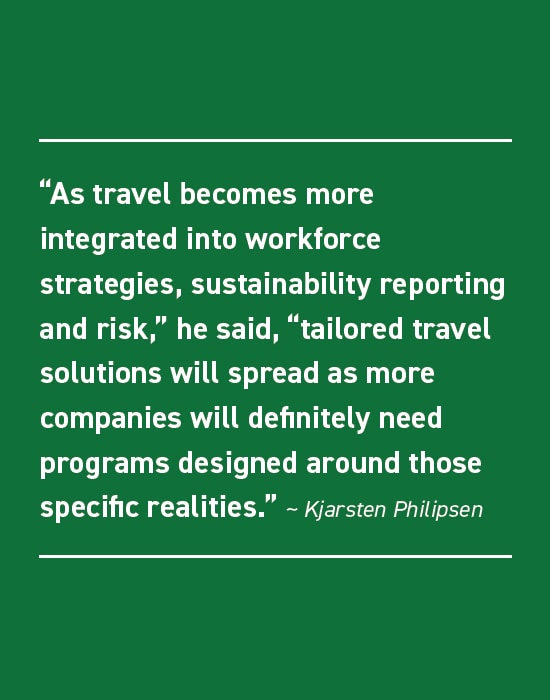
Travel Management Companies—ranging from legacy providers to new, tech-first providers—are at the forefront of tailored programs. Some legacy TMCs have offered industry-specific solutions for years, while newer entrants are adapting to company and industry needs by leading with innovations in online booking tools (OBTs) and mobile capability. Global macro conditions are also playing a key role in the uptick in demand for tailored solutions and services, which BCD SVP Kjarsten Philipsen characterizes as “an evolution rather than a shift.”
In the past, most companies and travel managers accepted fairly generic management programs because the overall environment was simpler, Philipsen said. “What’s changed is the complexity of the how, the why, and where people are traveling.” Companies are now facing unpredictable and rapidly changing macro conditions, particularly in the economic and geopolitical realms.” That has prompted some to move beyond one-size-fits-all programs and rethink where flexibility and governance should live in their service models and tech stacks.
- Program Differences
- Program Resilience
How tailored programs are different
In practice, “tailored” most often shows up in program design and delivery—how booking, servicing, policy and reporting are configured for a specific operating reality, according to Lloyd. “Technology helps support this, but the main difference usually sits in the way the program is set up and run,” she said.
While the foundational elements of every managed travel program include booking, servicing, supplier relationships and reporting, she added, how those elements are configured can look different in a tailored program.
Philipsen noted that tailored solutions start from a position of understanding the needs and business objectives of a company and designing around those. “Standard offerings are geared for plug-and-play efficiency, whereas tailored programs are optimized for effectiveness and business outcomes,” he said. According to Philipsen, tailored managed travel programs strike a balance between customized service and specialized technology, depending on the industry.
“I see more customers lean heavily towards specialized technology for managing guest travel or project-based travel at scale. Others require services, including deeper consulting, or tighter integration with risk and or sustainability functions,” Philipsen said. “I’d say the common thread here is that tailoring isn’t about a single product. It’s how technology, service and expertise come together in a holistic manner and solution.”
Tailored programs provide relevance and resilience
Once those building blocks are set, the value of tailoring becomes clearer: Programs feel more relevant to travelers and more resilient for organizations navigating constant change.
Tailored managed travel programs will benefit companies and travelers in different ways, depending on why and how a program has been customized. Broadly speaking, according to Lloyd, “The main benefit is relevance.” When travel policies, servicing and communication reflect how employees actually travel, people find it easier to follow the program. “That improves compliance and gives the organization better visibility of travel activity,” she said. For the company, that relevance also means the program supports broader priorities such as cost control, risk management and employee experience.
According to Philipsen, a tailored managed program also provides an organization with the flexibility and governance to respond to change without having to overhaul the entire program when faced with internal changes or a major event or shift in marketplace or macro conditions.
“It isn’t really about customization as an end goal. It’s really about resilience,” he said. “Companies and their programs need to hold up in a world that is constantly changing, whether that be cost pressure, distribution shift, sustainability, science-based targets or risk events. They want the ability to adapt their programs as business needs change.”
That emphasis on resilience is reflected in requests for proposals (RFPs) that BCD is now seeing that are focusing on more than just savings and compliance. “That ability to evolve rather than react, and doing so calmly and deliberately, is something that a lot of companies are thinking about now,” he said.
Adoption Across Industries
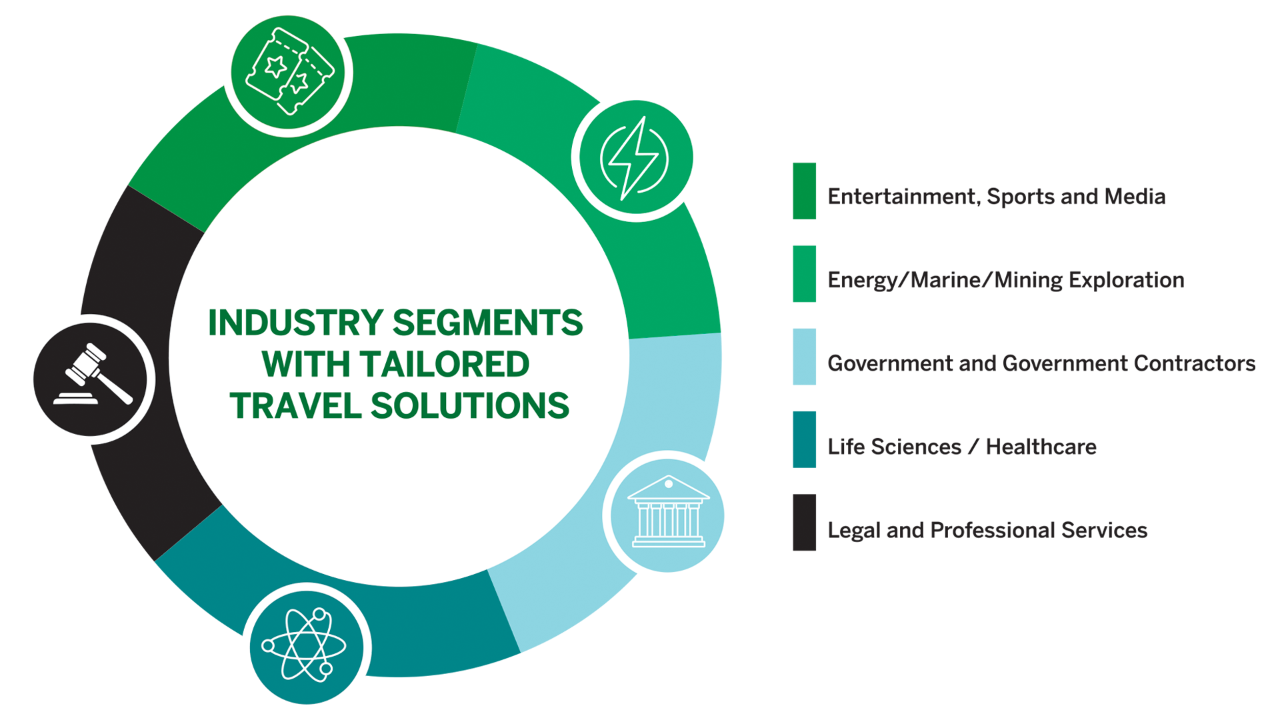
Tailored Programs in Action
The following examples illustrate how tailoring can take very different forms, based on company needs.
- Keller North America
- ITV America
- Elevance Health
At Keller North America, a global geotechnical constructor contractor, travel manager Megin Dressel built the company’s tailored travel program from the ground up because the traditional TMC and OBT relationships were “a difficult fit for the way we travel.”
That includes “an enormous amount of crew travel,” comprising almost 80% of Keller’s overall lodging spend. Many crew members don’t have online access to the booking tool, company phones or email addresses, so Dressel needed a tailored program that enables hotel reservations while coordinating transportation to job sites and managing payments.
“The program we built is very old school; it’s stuff that companies probably were doing in the ‘80s and ‘90s where you partner with a travel agency, negotiate the heck out of your hotels rates, and make reservations by phone,” Dressel said. But it all supports projects that can require crew deployment with as little as 48 hours’ notice.
ITV America, a global media and entertainment company, requires a significant amount of group travel. The company books travel for 50 to 80 productions each year, ranging from a single episode to an entire series or show.
ITV’s production coordinators are the main hub for travel on each project, handling all crew bookings and reservations. The number of productions that will require travel, crew size and trip duration might be completely unpredictable. “It’s as volatile as the stock market,” said Donna McGovern, ITV Director of U.S. Travel.
McGovern is evaluating technology that will enable the company to consolidate group-travel data, streamline coordinators’ booking workflows and improve cost efficiency. She is taking a close look at OBTs that have recently come online with the ability to track and manage the flow of budget spend, capture reimbursement and reconcile budgets when productions wrap.
A buyer with another global entertainment company explained that the nature of the entertainment industry requires “close working relationships with our vendors so they understand the variety of travelers we have and can fulfill those traveler needs.” On the hotel side, those needs may range from an executive who requires heightened security and privacy to talent that has worked all night and needs a quiet room and food service at odd hours. Other buyers in this segment have often noted detailed ground transportation requirements of clients.
Elevance Health, a healthcare, insurance and pharmaceutical services organization, is currently in the midst of an RFP review to select a TMC. According to Dan Stagnitta, travel procurement consultant, data control and privacy are key issues in the search.
“We have a very compliance-heavy, compliance-driven organization,” Stagnitta said. The company works with government contracts that have mandated requirements for suppliers, most prominently regarding per diem caps on hotel rates.
As TMCs and booking tools deal with highly sensitive personally identifiable information (PII), Stagnitta is working with Elevance’s data privacy teams while conducting discussions with potential TMC providers on their capability to add layers of privacy protection to their standard offering. “It’s basically a prerequisite for us to be able to engage in a partnership,” he said.