



Travel Managers Identify 2026 Challenges and Priorities, And Strategies to Navigate
Travel managers are starting the year balancing cost containment with an anticipated increase in travel volume and heightened traveler expectations. Most have plans to respond to a variety of expected challenges, from changing macro conditions to internal pressures to meet the evolving needs shaping their own travel programs.
That’s the big-picture perspective for 2026 from a survey of 111 travel
managers conducted by the BTN Group exclusively for Enterprise Mobility.
The dual focus on containing costs while also meeting intensifying traveler expectations has repeatedly surfaced in various reports this year. For
some, traveler demographics have changed as younger employees are
now traveling for business. Others note that the role and volume of travel within organizations have morphed in recent years. Cost management and pol-icy compliance have likewise emerged, according to 149 corporate travel and procurement professionals surveyed last fall by the Business Travel
Show America.
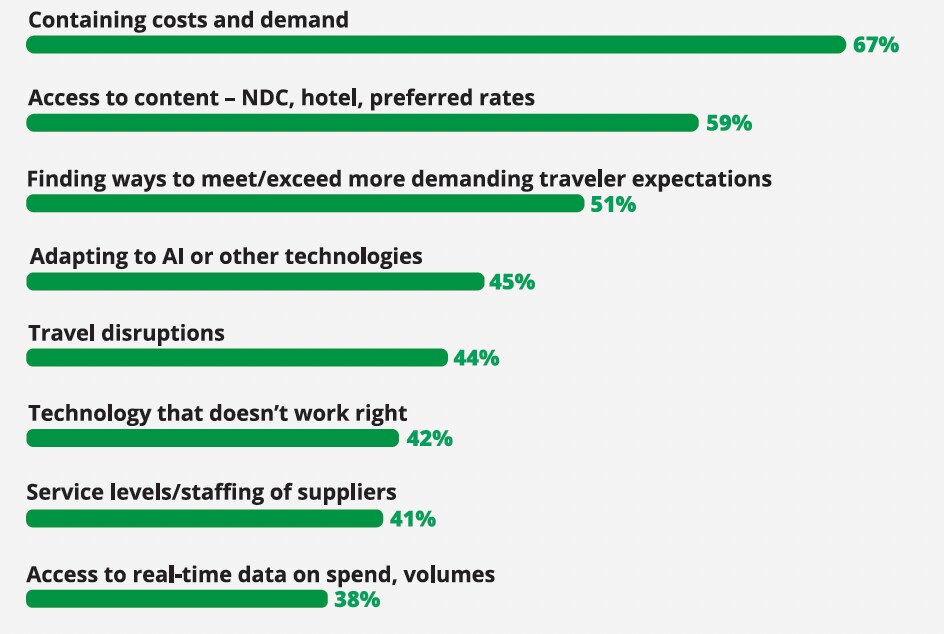
What Aspects of the Travel Landscape Most Concern You for 2026 and Likely Will Require Your Attention?”
- Challenges
- Plans to Address
In 2026, the majority of travel managers expect to focus on three top areas of concern: containing costs and demand; accessing content including NDC, hotel and sup-plier rates; and finding ways to meet or exceed more demanding traveler expectations. Many are also concerned about adapting to AI technologies, dealing with faulty technology and travel disruptions, and inadequate supplier service and staffing levels.
What Do You Expect to Be Your Top Challenges in 2026?
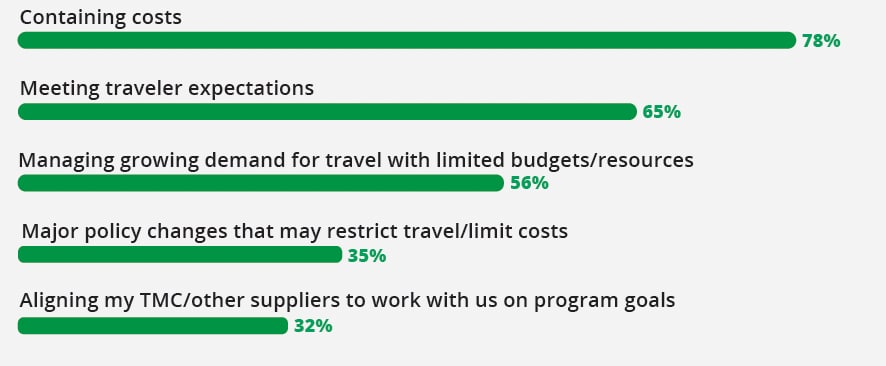
Selecting and implementing new technology providers will be a top challenge for nearly 30% of travel managers next year, while more than 20% expect have to select and implement a new online booking tool.
One survey respondent identified the interconnected nature of top challenges: “We need to come up with a $3-million cost savings in travel for 2026 while having implemented a new TMC in late 2025, which has had some bumps the road.
Plans to Address
While it is difficult to know exactly what challenges the new year will ring in, most travel managers say they are preparing with plans for:
- Increasing communication: Buyers said they expect to increase communications internally and/or with suppliers and technology providers as policy and programs could change in response to unexpected conditions. Creating town halls and “listening sessions” to present program goals and get traveler feedback, hosting educational and feedback forums for travelers and administrative staff, and initiating quarterly Q2 FY26 Whitepaper: Ready for the Next Generation of Business Travelers? meetings with executive leadership are among the top strategies. One travel manager noted that to meet the myriad travel management challenges in 2026, “senior leadership engagement will be key.”
- Strengthening partnerships and collaboration: Others plan to work with key stakeholders, such as finance and sustainability “to develop strategies to control travel spend and emissions.” Or “work with preferred suppliers to reduce costs while meeting travelers’ needs.” Another plans more “communication and engagement with our change management team. They have helped us navigate major changes to our travel tools in the past.”
Many travel managers singled out their TMC partnership as a key driver to successfully navigate challenges that come up this year. While some plan to collaborate with their existing TMCs, others expect their new TMC to help them drive better traveler communications, reporting and technologies, perhaps including AI.
On the 2026 Agenda
- New Partner
- Cost Control
- Compliance
Implementing a new TMC and/or OBT
Implementing a new TMC or an online booking tool are key to helping managers solve top traveler issues, including “traveler experience and bringing more value to our company,” or “keeping up with our travel demand.” Consistent with this the findings of this study, nearly one-third of respondents to a Global Business Travel Association poll at the start of 2025 were reevaluating or changing their TMC with four in ten citing dissatisfaction with TMC technology, 37% listing service quality concerns and 20% identifying difficulty with NDC bookings as reasons.
Cutting or controlling costs
Strategies vary, from restricting trips to “business-critical travel only” to limiting event participation and increased monitoring of pre-trip approvals, reconciliations and auditing. One buyer said they are “requiring our employees to drive rather than fly to company meetings that are mostly in the Midwest,” and “working with travel partners so they understand our goals.”
Changing or tightening travel policy and compliance
Some travel managers are overhauling their policies or adding new restrictions to contain costs. Others said they are adding sections on executive travel and meetings or increasing compliance controls. Specific feedback follows, as quoted:
- Stronger focus on traveler compliance governance, holding travelers and their expense approvers accountable.
- Revamping travel, expense and card policies in totality.
- Implementing pre-trip approvals for higher-cost trips.
- Adding a section regarding tipping, revising cabin classes allowed for longhaul travel, and adding an expense reporting timeline.
- Adding in new policy for meetings and events as we do not currently have one.
- Rolling out executive level policy with more restrictions.
- Renewing contracts with more benefits for us from the vendors.
- Tightening travel through policy or budget changes, more monitoring of compliance, and negotiation with suppliers.
- Continue to enforce preferred suppliers to help bring costs down and secure duty of care. Maybe implement a rideshare policy/partner.
Some survey participants outlined comprehensive strategies to handle 2026 challenges:
- We will be switching long-term stays from vacation rentals to corporate housing while creating a supporting policy. We will continuously review our TMC and booking platform to ensure service levels, especially with ‘improvements’ that may not improve our traveler experience, policy compliance, or oversight. We will also bring group bookings into a program to develop better oversight and consistency.
- Our travel program will continue to work with our TMC and suppliers to optimize their products and services while also evaluating their pricing and service levels. We will continue to adhere to our strict travel policy to reduce auditing risk. We will also continue to watch our funding sources to ensure we are aligned with our policy and spending.
- Ideally we’ll hire a consultant to help us outline and implement a travel program that’s fit for purpose, and ready to succeed.
Spotlight on Compliance
With controlling travel costs and meeting traveler expectations topping the list of anticipated challenges in 2026, travel managers have their work cut out for them as they try to balance two seemingly conflicting goals.
“When budget pressures loom, it’s often the traveler who suffers, but that doesn’t have to be the case,” says Mike Guadagnoli, Vice President of Business Rental Sales and Global Operations for Enterprise. “Finding the right travel partner who will support policy compliance and cost control efforts without sacrificing traveler experience is key.” In business car rental, Enterprise and National do just that. The company’s Emerald Club loyalty program offers several benefits for companies and employees alike.
Employee Travelers Enjoy:
- Speed and convenience. Travelers can bypass the counter and go straight to their vehicle.
- Vehicle choice. With their midsize car reservation, travelers can pick any vehicle from the Emerald Aisle with no cost to upgrade.
- Free rentals. Emerald Club members can earn and redeem free rental days at participating locations.
For Businesses, Emerald Club Offers:
- Improved policy compliance. Businesses pay only the midsize rate regardless of which vehicle an employee traveler chooses from the Emerald Aisle.
- More accurate forecasting. Adherence to negotiated midsize rates makes it easier to predict future travel spend.
- Satisfied travelers. No waiting in line, no-cost upgrades, and the bonus of loyalty rewards make car rental stress-free and more enjoyable.

“With Emerald Club, compliance comes naturally,” says Guadagnoli. “Travelers feel empowered to choose a vehicle they actually want to drive and, no matter their choice, there’s no impact on cost. That’s a win for everyone.”
2025 Top Priorities are Key Challenges in 2026
As they start the new year, many buyers expect to continue to focus on the same three priorities they did in 2025 but have added dealing with uncertainties and disruptions to the mix.
What Were the Top 3 Priorities in Your 2025 Travel Program?
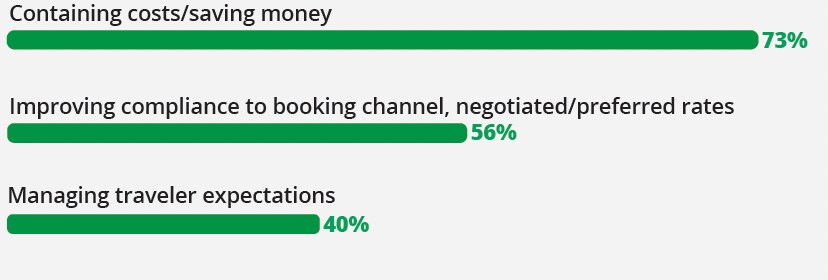
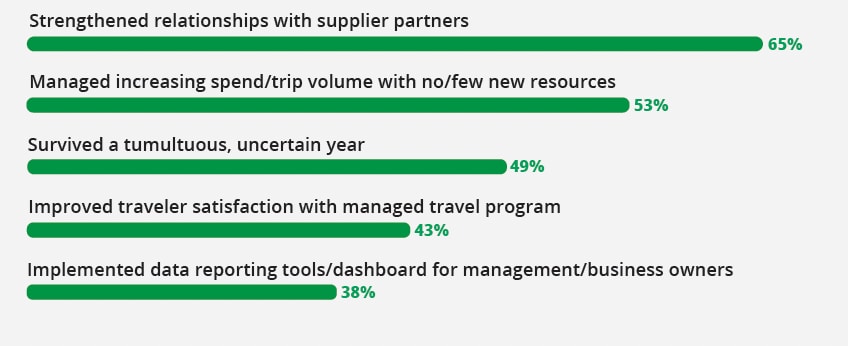
Despite the challenges that characterized the business travel landscape in 2025, travel managers identified accomplishments that strengthened their programs, most notably, turning to partners to help them solve issues.
What Are You Most Proud That You and Your Team Accomplished in Your 2025 Program?
Concluding Thoughts
At the start of 2025, few anticipated the impact that tariffs, the government shutdown, immigration changes and other government policies would have on travel programs and budgets. But travel managers have learned to be resilient in navigating a multitude of unexpected events in recent years. Perhaps that is why so many buyers outlined an attitudinal approach to handling challenges this year rather than identifying specific strategies. These included: “being creative and proactive by learning what others are doing”; “taking all learning opportunities available to me”; and “remaining flexible and open to new ideas and strategies.”
Value of Travel Manager Growing
As noted in a recent article by the Institute of Travel Management on the evolving role of the travel manager, “We are likely to see a further expansion of the current travel manager role, with wider responsibilities, more strategic expectations, and cross-functional alignment. As the remit evolves, and internal communications develop, the value of the travel function within the business will continue to rise.”
Disclosure: This whitepaper was created by Northstar Travel Group, LLC and paid for by Enterprise Holdings,. The content of this white paper was developed solely by Northstar Travel Group, LLC, and all views and opinions contained herein are strictly those of Northstar Travel Group, LLC. Enterprise Holdings, Inc. and its affiliates and do not necessarily endorse the content contained herein.